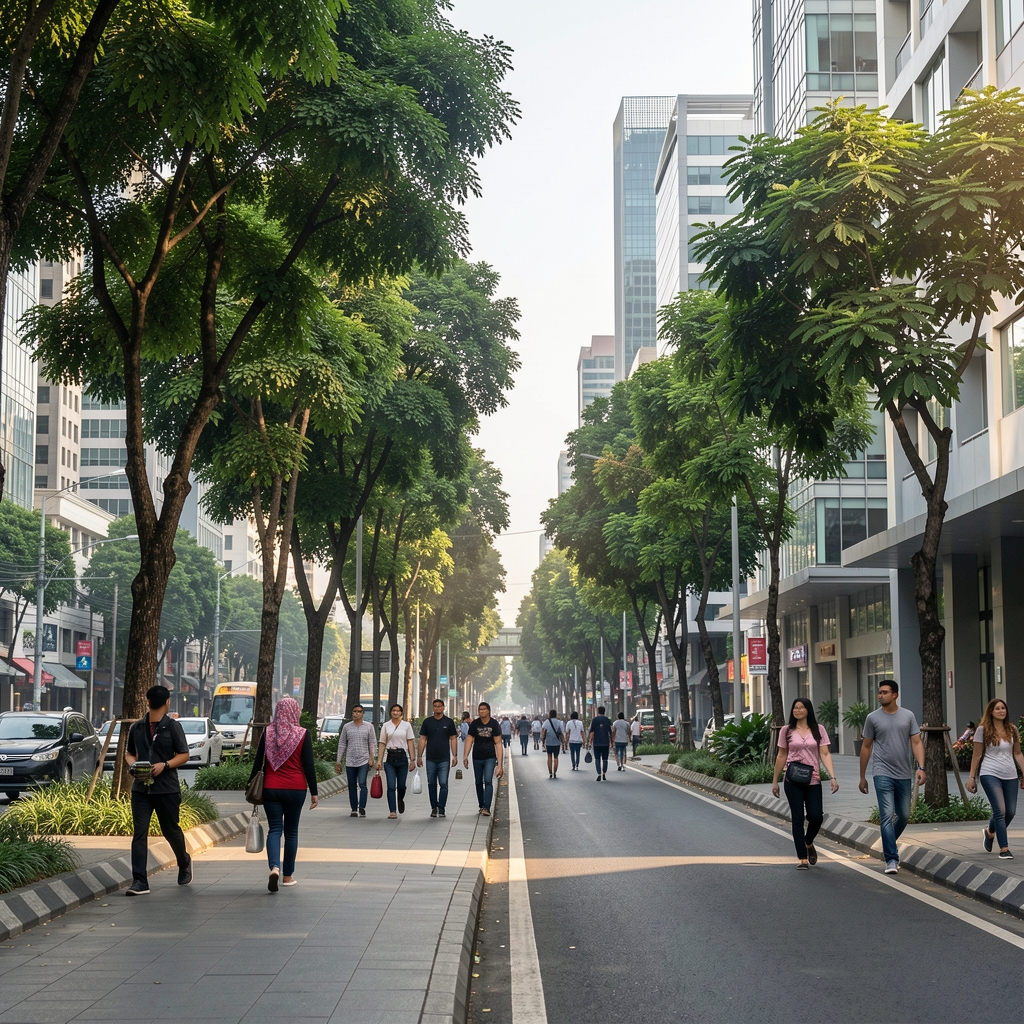
Green Space Access and Its Documented Associations
A growing body of urban health research has examined the relationship between proximity to green space — parks, tree-lined streets, waterways and natural areas — and a range of well-being indicators. Studies conducted in both high-income and middle-income urban settings suggest associations between greater green space access and lower stress marker levels, higher rates of physical activity and more favourable self-reported mental states, though the direction of causality is difficult to establish given that higher-income neighbourhoods tend to have both more green space and other well-being advantages.
Within the Indonesian urban context, green space access is highly uneven. Jakarta's urban planning history has resulted in significant variation between neighbourhoods, with formal residential areas and newer developments often providing more park access than high-density informal settlements. The relevance for well-being research is that environmental factors operate at the neighbourhood level, not merely at the individual level — meaning that individual choices about diet or activity take place within a structural context that either facilitates or constrains them.
Heat, Humidity and Physical Exertion Patterns
Indonesia's equatorial climate means that outdoor temperature and humidity levels are a persistent physiological consideration throughout the year. Average temperatures in Jakarta range between 26°C and 32°C, with relative humidity typically between 70% and 90%. Under these conditions, thermoregulation during physical exertion requires more active sweating than in cooler, drier environments, which affects fluid and electrolyte balance during and after physical activity.
This climate context has implications for how physical activity patterns among Indonesian men are structured. Research on physical activity in tropical climates suggests that outdoor exertion tends to shift toward cooler parts of the day — early morning or after sunset — and that heat-adapted populations maintain activity levels through adaptation of timing rather than reduction of intensity. The fluid balance demands of activity in hot, humid conditions are higher than standard guidelines (developed largely in temperate-climate research contexts) typically reflect.
Integrating Environmental Context into Understanding
The factors described in this article — air quality, light patterns, noise exposure, green space access and climate — do not operate independently. They form an interconnected environmental profile that shapes the physiological and psychological baseline from which any individual navigates daily life. Understanding well-being in this context requires treating the environment not as a neutral container but as an active participant in the body's daily regulation.
This does not mean that individual choices are irrelevant — they clearly are not. It does mean that frameworks for understanding male well-being that focus entirely on individual behaviour and nutrition while ignoring the structural and environmental context in which that behaviour takes place offer a partial and potentially misleading picture.